








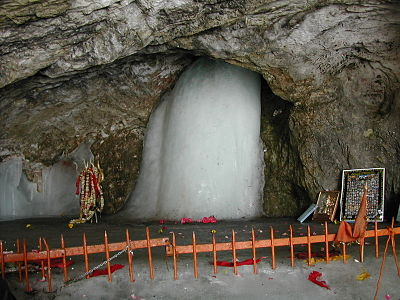
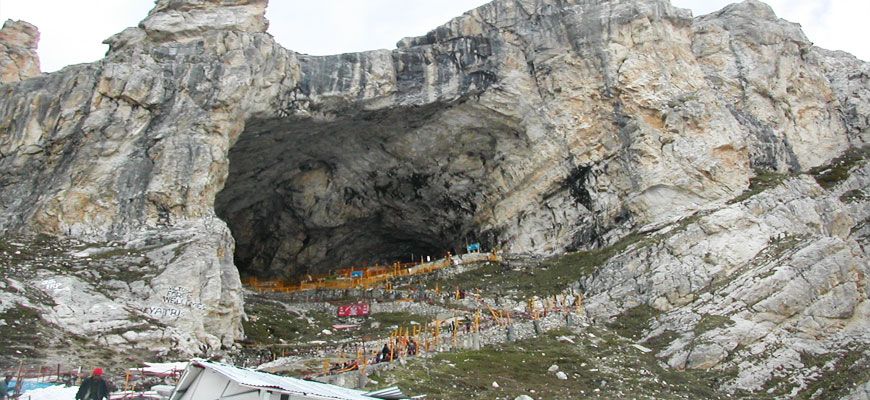
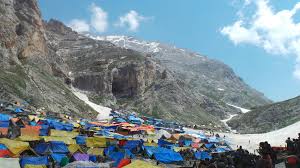
The Amarnath Cave Temple is one of Hinduism’s most sacred shrines dedicated to Lord Shiva, located in the Union Territory of Jammu & Kashmir. Situated at an altitude of 3,888 meters (12,756 ft) in the snow clad Himalayas, the cave lies about 141 km from Srinagar, accessible mainly through the scenic Pahalgam route. For most of the year, the cave remains covered in snow, opening only for a short period during summer when lakhs of devotees undertake the challenging yet deeply spiritual Amarnath Yatra.
🌟 Historical
Background
The
Amarnath Cave has been revered for centuries. It is mentioned in the ancient
Kashmiri chronicle Rajatarangini and referenced in texts like Rajavalipataka,
confirming its historical and pilgrimage importance.
According
to folklore:
🕉 Deity:
Lord Shiva (Amarnath)
The
shrine houses a naturally formed ice Shiva Linga, symbolizing Lord
Shiva.
Devotees believe that this is the place where Shiva revealed the secret of
immortality (Amar Katha) to Goddess Parvati.
❄️ The Holy Ice Shiva
Linga
Inside
the 40‑meter‑high cave, droplets of water freeze and form a vertical ice
stalagmite, worshipped as the Shiva Linga.
Key beliefs include:
🚩 Amarnath
Yatra (Annual Pilgrimage)
The Amarnath
Yatra is one of India’s most significant pilgrimages. It draws hundreds
of thousands of devotees every year.
Yatra
Highlights
There are two main routes to reach the cave:
1.
Pahalgam Route (Traditional Route – 43 km trek)
Route:
Pahalgam → Chandanwari →
Sheshnag → Panchtarni →
Holy Cave
This route is longer but scenic, with gradual elevation.
2.
Baltal Route (Short Route – 16 km trek)
Route:
Baltal →
Domel →
Barari →
Sangam →
Holy Cave
This
is a steeper, more difficult trek but allows a same‑day return.
🏔 Legend
of Shiva’s Journey to the Cave
According
to mythology, Lord Shiva shed his companions one by one during his journey to
reveal the Amar Katha:
Here,
they manifested as ice lingam (Shiva) and yoni (Parvati).
🛕 Facilities
for Pilgrims
During
the Yatra, several services support devotees:
🔐 Security
Arrangements
Given
the sensitive terrain and past disturbances, the Yatra is protected by:
Safety
arrangements ensure secure passage for pilgrims throughout the route.
VISITOR GUIDE
Map :
Helpline Number: 14464
Toll-Free Number: 18001807199 / 180018071987
Email Support: sasbjk2001@gmail.com
Official Website: https://jksasb.nic.in
Office Contact Numbers
Srinagar Office (May-October): 0194-2313146, 0194-2313147, 0194-2313148, 0194-2313149
Jammu Office (November-April): 0191-2555662, 0191-2503399
Additional Yatra Help
NDRF Helpline: 011-23438252, 011-23438253
Kashmir Divisional Helpline: 0194-2496240
JPCR Pahalgam: 01936-243233, 01936-243018
By
Air
By
Rail
By
Road
🌄 Nearby
Attractions
1.
Mamaleshwar Temple
An
ancient Shiva temple believed to date back to 400 AD, located close to
Pahalgam.
2.
Martand Sun Temple
A
magnificent 8th‑century sun temple built by King Lalitaditya, now in ruins.
3.
Gadsar Lake
A
breathtaking high-altitude lake, also called the Valley of Flowers.
4.
Betaab Valley
A
scenic valley near Pahalgam, named after the Bollywood movie Betaab.
🔔 Temple
Timings
6:00
AM – 6:00 PM (during Yatra season)
Aarti: 7:30 AM & 5:00 PM
📅 Best
Time to Visit
During
the official Shravani Mela (July–August), when the ice linga is fully
formed and weather is relatively favorable.
🗓 Registration
Pilgrims
must register one month before the Yatra via authorized Yatra
registration centers or official portals.